
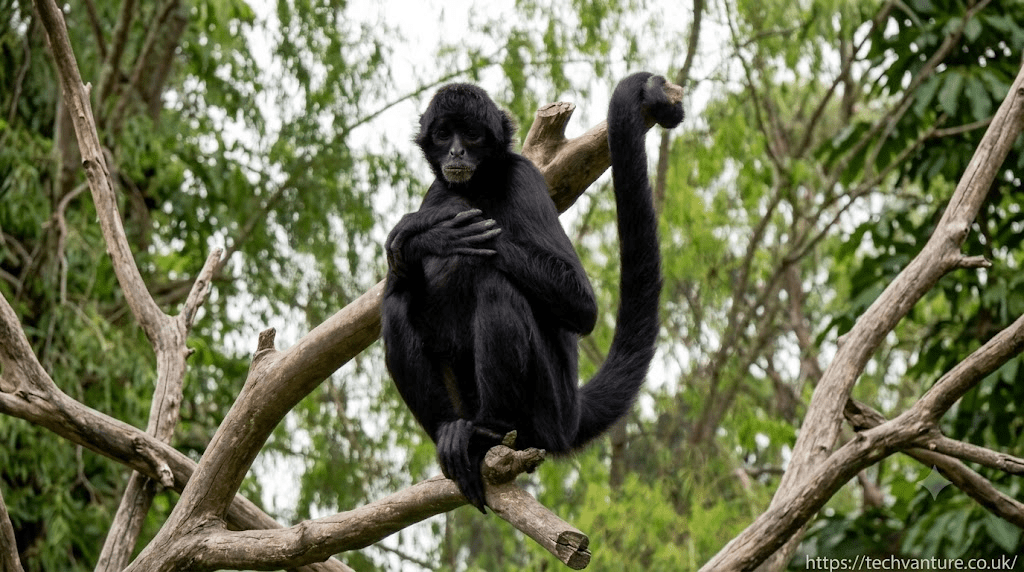
The black spider monkey is one of the most fascinating creatures in the South American rainforest. These intelligent, agile primates are known for their long limbs and impressive acrobatic skills. They play a vital role in keeping their forest home healthy and thriving.
In this article, we will explore the world of the black spider monkey. You will learn about where they live, what they eat, and the challenges they face. We will also look at their unique social behaviors and physical traits. Let’s begin our journey into the treetops to discover what makes the black spider monkey so special.
Table of Contents
What is a Black Spider Monkey?
The black spider monkey, scientifically known as Ateles paniscus, is a large primate from South America. It belongs to the Atelidae family, which includes other spider monkeys and woolly monkeys. This species is one of the largest primates found on the continent . People often call them the Guiana spider monkey or the red-faced spider monkey .
These monkeys get their “spider” name from their long, spindly arms and legs. Their appearance and movement through the trees can remind people of a spider. However, these are large monkeys, not insects. Their bodies are covered in glossy black fur, which is why they are called “black” spider monkeys .
Physical Characteristics of the Guiana Spider Monkey
Size and Weight
The Guiana spider monkey is a substantial animal. Males are a bit larger than females, which is a trait known as sexual dimorphism. An average male measures about 54.5 cm in head-body length and weighs around 9.1 kg. A female is slightly smaller, measuring about 54 cm and weighing roughly 8.4 kg . Their tails are remarkably long, adding another 60 to 80 cm to their total length. This tail is a crucial tool for their daily life.
Appearance and Features
These monkeys are mostly jet-black all over. However, their face stands out. Adults have a naked patch of skin on their face that is pink or reddish in color . This is why they are also known as the red-faced spider monkey. Some individuals might have a few short, white hairs on their muzzle . Their fur is long, silky, and glossy, which makes them quite striking to see in the wild.
The Prehensile Tail: A Fifth Limb
The black spider monkey’s tail is one of its most amazing features. It is prehensile, which means it can grasp and hold onto objects. This is an adaptation for life in the trees . The tail acts like a fifth limb. It is incredibly strong and can support the monkey’s entire body weight.
The underside of the tail tip is hairless and has padded skin, much like a human palm. This gives the monkey a better grip . They use their tail for many things. They wrap it around branches for stability while sitting. They also hang from it to reach for fruit on fragile branches that cannot support their full weight . For the Guiana spider monkey, the tail is as useful as its hands and feet.
Where Do Black Spider Monkeys Live?
Geographic Range
These monkeys are found in a specific region of South America. Their home is in the northern part of the continent, north of the Amazon River . Their range includes the countries of Guyana, Suriname, French Guiana, and the northern parts of Brazil . In Guyana, they are not found west of the Essequibo River . They prefer areas that are far from human populations.
Habitat and Rainforest Home
Black spider monkeys are creatures of the tropical rainforest. They favor pristine, mature tropical forests that are undisturbed . They are especially adapted to life in the forest canopy. The canopy is the upper layer of the forest where the treetops meet. They spend a huge portion of their time there, with one study showing they spend about 90% of their time in the upper canopy .
These monkeys seldom venture into disturbed habitats, like areas where trees have been cut down. This makes them very vulnerable to a process called forest fragmentation. Fragmentation happens when large forests are broken up into smaller, isolated patches . They prefer forests where the canopy is over 25 meters high, which provides them with the food and pathways they need to move around.
Diet and Eating Habits: What Do They Eat?
The Guiana spider monkey is an omnivore, which means it eats both plants and animals. However, the vast majority of its diet comes from plants. Their feeding habits play a significant role in the health of the rainforest.
Fruit is Their Favorite
Fruit is the most important part of a black spider monkey’s diet. During the wet season, fruit is abundant and makes up a large percentage of their food. In fact, fruit can account for about 85% of what they eat . They have a particular fondness for fleshy berries, pods, and drupes (fruits with a pit) . They often eat the fruit whole and spread the seeds.
Other Food Sources
When fruit is harder to find, especially in the dry season, they adapt. They will eat other parts of the forest to survive. This includes leaves, flowers, and even decaying tree bark . They may also consume insects like termites and caterpillars for protein. They are also known to eat honey, roots, fungi, and occasionally eggs . Their diet changes with the seasons, showing how adaptable they are.
Role in the Ecosystem: Seed Dispersal
The black spider monkey is more than just a resident of the rainforest; it is a gardener. Because fruit makes up the bulk of their diet, they are one of the most important animals for seed dispersal . When they eat fruit, they swallow the seeds. These seeds travel through their digestive system and are later deposited in their droppings far from the parent tree .
This process is vital. It helps to spread plant species across a wide area. It prevents trees from growing too close together, which reduces competition for resources. This allows the forest to continue growing and thriving . Without the Guiana spider monkey, the entire structure and diversity of the rainforest would be very different.
Social Behavior and Group Dynamics
Troop Structure
Black spider monkeys are social animals, but their groups are structured differently than other primates. They live in large communities or “troops” that can number from 15 to 30 individuals . Troops are often made up of several adult females, a few adult males, and their young . However, these large groups are rarely all together at the same time.
Fission-Fusion Society
They have what is known as a “fission-fusion” society. This means the large group will split into smaller, temporary subgroups to travel and find food during the day . A typical subgroup might have just 2 or 3 individuals . At night, these subgroups come back together to sleep in the same area. This strategy helps them find enough food while still keeping their social connections.
Communication in the Treetops
Monkeys are smart and have complex social lives. To maintain their society, the red-faced spider monkey uses a variety of communication methods.
Vocalizations
They are very vocal animals. They use different sounds to communicate with each other. A loud scream can warn others of a predator, like a harpy eagle. A grunt or a whimper might be used during a friendly interaction. They also bark and whistle to alert others to food sources or to defend their territory .
Other Forms of Communication
They also communicate through smell and sight. They are known to smell and lick each other’s chests and genital areas. This helps them recognize friends and remember past relationships . Visually, they communicate by shaking tree branches, nodding their heads, scratching their chests, and swinging their arms . They even throw sticks and branches at potential threats on the ground . This is an effective way to scare away a predator or an intruder.
Reproduction and Lifespan
The Reproductive Cycle
The Guiana spider monkey has a very slow reproductive rate. Females give birth to only one infant at a time . Their gestation period, or pregnancy, lasts about 7.5 months . After the baby is born, the mother will not give birth again for another 3 to 4 years . This slow rate is one reason the species is so vulnerable to threats.
Infant Development
The bond between a mother and her baby is very strong and lasts a long time. For the first few months, the infant clings to its mother’s chest and tail. From about 6 to 9 months, it starts riding on her back . The young monkey stays with its mother for at least 3 years, learning how to survive in the forest . They learn where to find food, how to move through the trees, and how to interact with other troop members. They reach sexual maturity at around 4 to 5 years of age .
Lifespan
In the wild, the black spider monkey can live for about 20 years. In captivity, where they are safe from predators and have a steady food supply, they can live much longer. The oldest known black spider monkey in captivity lived to be 46 years old . This long lifespan, combined with their slow reproduction, makes it difficult for their population to recover quickly.
Threats to the Red-Faced Spider Monkey
The black spider monkey is facing serious challenges. The main threats come from human activities. The International Union for Conservation of Nature (IUCN) classifies this species as Vulnerable. This means it is at high risk of becoming endangered in the wild .
Habitat Loss and Deforestation
The biggest threat to these monkeys is habitat loss. Tropical rainforests are being destroyed at an alarming rate. Trees are cut down for lumber, and land is cleared for agriculture and cattle ranching. The black spider monkey relies on large, continuous areas of undisturbed forest. When their habitat is broken up into smaller fragments, their population is split. These smaller groups have less food and are less genetically diverse. They are also forced to move closer to human settlements, which increases the risk of hunting .
Hunting and the Pet Trade
In some areas, the Guiana spider monkey is hunted for its meat. This is known as bushmeat hunting . They are large animals, so they provide a lot of meat. Even local hunting can put pressure on their populations because their birth rate is so slow. In other cases, infants are captured and sold illegally as pets . This is a cruel practice that often sees the mother killed to get to her baby.
Conservation Status and Efforts
The Guiana spider monkey’s status is a cause for concern. The population has fallen by an estimated 30% over the last 45 years . This is a direct result of the threats we have discussed. Conservation efforts are underway, but more work is needed to ensure their survival.
Protection and Laws
The species is listed on Appendix II of the Convention on International Trade in Endangered Species (CITES). This means that international trade of the animal is regulated to prevent it from threatening their survival . Many of the countries where the monkey lives have also established protected areas and national parks. These parks, like the Iwokrama Forest in Guyana, provide a safe haven for the monkey and other wildlife .
What Can Be Done?
Protecting the rainforest is the most critical step. This means supporting sustainable practices and reducing deforestation. Organizations like the World Wildlife Fund (WWF) work to protect the habitats of animals like the black spider monkey . Ecotourism is also a powerful tool. When local communities can earn money from protecting the rainforest and its wildlife, they are less likely to hunt the animals or cut down the trees. By raising awareness and supporting these efforts, we can help ensure that the acrobatic black spider monkey continues to thrive.
Conclusion
The black spider monkey is a remarkable animal that is essential to the Amazon rainforest. From their acrobatic movements to their role as seed dispersers, they are a key part of their ecosystem. However, they face serious threats from habitat loss and hunting. Their slow reproduction rates make them especially vulnerable.
Understanding these amazing primates is the first step in protecting them. By supporting conservation efforts and sustainable practices, we can help safeguard their future. Share this article to help spread awareness about the Guiana spider monkey. Let’s work together to make sure these majestic creatures continue to swing through the treetops for generations to come.
Frequently Asked Questions
Is the black spider monkey an endangered species?
The black spider monkey is currently listed as Vulnerable by the IUCN . This means the species is at a high risk of becoming endangered in the wild. Their population is decreasing primarily due to habitat loss and hunting.
Where can you find the Guiana spider monkey?
You can find the Guiana spider monkey in the northern parts of South America. They are native to countries like Guyana, Suriname, French Guiana, and northern Brazil. They are found specifically in areas north of the Amazon River .
What is the diet of the black spider monkey?
The black spider monkey is an omnivore, but its diet is mostly fruit. When fruit is scarce, they will also eat leaves, flowers, insects, and tree bark . They play a crucial role in the ecosystem by dispersing the seeds of the fruit they eat.
How do black spider monkeys use their tails?
A black spider monkey uses its prehensile tail like a fifth limb. They use it to grasp branches for stability, hang from trees to reach food, and to help them move from branch to branch. The tail is strong enough to support the monkey’s entire body weight .
What are the main threats to the black spider monkey?
The main threats are habitat loss and hunting. Deforestation destroys their home in the rainforest. They are also hunted for meat and their infants are sometimes captured for the illegal pet trade .
